


COVA Reflection & Application
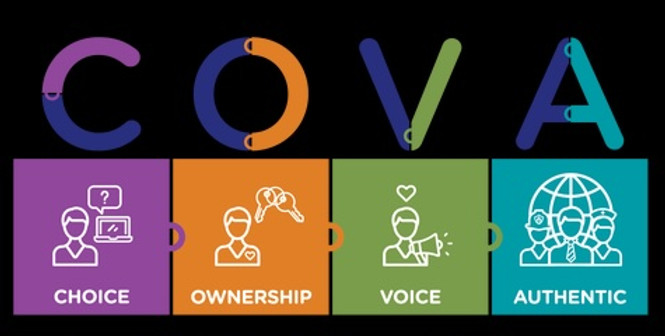
From COVA: Inspire learning through choice, ownership, voice, and authentic experiences (cover page), by D. Harapnuik and T. Thibodeaux, 2023, Learner's Mindset Publishing. Copyright 2023 by Learner's Mindset Publishing.
Embracing the COVA (Choice, Ownership, Voice, and Authentic learning) model has profoundly reshaped how I understand learning, teaching, and leadership. From the beginning of this program, I recognized that my education would be driven by authentic assignments that encouraged creativity, risk-taking, and independence. Early in my coursework, I discovered that learning was no longer about following a predetermined path but about designing projects that reflected my personal interests and professional goals. This shift allowed me to take meaningful ownership of my learning, transforming assignments into opportunities for self-expression and authentic growth.
Initially, the freedom to direct my own learning felt daunting. Stepping away from structured guidance required a new mindset—one built on confidence, reflection, and deliberate planning. Over time, I found that setting clear goals, managing my time wisely, and consistently tracking my progress created the structure I needed to succeed in a more flexible environment. Through collaborative discussions, my innovation proposal, and various presentations, I learned to express ideas that connected my personal goals with the broader mission of the AISD Virtual School. This journey reshaped my view of education as both an individual pursuit and a collective experience—rooted in collaboration, reflection, and shared purpose, which I captured in my implementation outline.
To adapt to this learner-centered environment, I adopted several key strategies. By remaining flexible and open-minded, I view mistakes as opportunities for growth rather than setbacks. Reflection journals, progress tracking, and goal-setting frameworks helped me stay accountable, while feedback from mentors and peers encouraged me to innovate and take risks. Collaborative projects enabled iterative improvement, reinforcing authenticity and fostering mutual trust. These experiences taught me that genuine learning flourishes in spaces that balance creative freedom with thoughtful structure.
As I grew more confident in my voice and vision, I began to connect my learning to real organizational contexts. Initially, addressing my organization as the intended audience felt daunting; however, with each project, I became better at articulating ideas that served both my goals and those of AISD Virtual School. Clarifying our shared values and aligning my contributions with institutional objectives helped me strengthen my voice as an educator and a leader capable of driving meaningful change in instructional design.
My journey with the COVA model also reframed how I perceive leadership. When I started the ADL program, I worried about leading change or encountering resistance. Yet, as I engaged with self-directed learning, I realized that leadership is not about command—it’s about influence, collaboration, and reflection. Viewing leadership through this lens empowered me to connect my learning to a collective vision and embrace a growth mindset as a continual process. Each success in my projects built confidence and turned apprehension into advocacy. Embracing challenges and learning from mistakes cultivates a growth mindset (Dweck, 2006).
One of the most impactful parts of this program is the ability to develop your idea and pursue it freely In many traditional classrooms, AI is often seen as a threat or a shortcut for students. My innovation plan challenges this perception by positioning AI as a partner in the writing process. English teachers face demanding workloads, often teaching more than 200 students, which makes individualized feedback difficult. AI tools like Grammarly, Quillbot, and ChatGPT provide scalable support, helping students brainstorm, revise, and refine their writing. Rather than replacing human judgment, these tools scaffold learning, engage metacognition, and promote self-assessment, allowing students to take ownership of their progress. By maintaining rigorous writing standards alongside AI integration, students learn to value process as much as product and reflect critically on their growth.
The alignment between COVA, Creating Significant Learning Environments (CSLE), and my personal learning philosophy is clear. Both frameworks emphasize that learning is most meaningful when learners are empowered to make choices and express their unique voices (Harapnuik, 2018). I’ve transitioned from focusing primarily on content delivery to adopting a process-oriented approach that champions creativity and curiosity. COVA and CSLE remind me that significant learning environments thrive when learners feel both supported and challenged—and when they are permitted to take risks. I’ve also learned the importance of extending grace to myself and to my students as we navigate the complexities of authentic learning together.
As I move forward, I plan to implement the principles of COVA and CSLE more intentionally within my organization. I will design classroom experiences that foster choice, ownership, and voice, integrating digital tools that empower students to connect their learning to real-world applications. By facilitating workshops with colleagues and encouraging reflective practice, I aim to cultivate a culture that normalizes experimentation, collaboration, and growth. Creating psychologically safe spaces where both students and educators can take risks will help sustain this learner-centered approach.
Ultimately, my journey through this program has affirmed that education is not merely about instruction—it is about transformation and providing alternative learning for students and teachers. Through the intentional application of COVA and CSLE, I’ve learned that authentic learning is both personal and communal, both creative and reflective. It empowers learners to become adaptable, self-aware, and lifelong seekers of knowledge. This philosophy continues to guide my action research and inspires me to lead with purpose, courage, and compassion, because education is not preparation for life; education is life itself (Main, 2023).
References
Dweck, C. S. (2006). Mindset: The new psychology of success. New York, NY: Random House
Harapnuik, D. K., Thibodeaux, T. N., & Cummings, C. D. (2018). Choice, ownership, and voice through
authentic learning opportunities. https://www.harapnuik.org/?page_id=7291
Main, P (2023, February 14). John Dewey's Theory. Retrieved from https://www.structural-
learning.com/post/john-deweys-theory